
If you were expecting free basic electricity on your latest prepaid purchase and got fewer units than usual, or none at all, you are not alone. Many Cape Town households are confused by how the free allocation works.
The biggest source of confusion is the idea that you simply qualify for free electricity every month. In reality, your tariff, property value and average electricity received over 12 months all play a role.
Your free allocation can also change when your average moves into another usage bracket.
Here is how the system works, why your free units may have disappeared and what you can do to keep track of your electricity every month.
- What is free basic electricity?
- How the free electricity system works
- Why your free basic electricity may have disappeared
- The three residential electricity tariffs explained
- How to track your monthly electricity usage
- What to do if you expected free electricity but received none
- How to avoid surprises next month
- The bottom line
What is free basic electricity?
Free basic electricity is a monthly electricity allocation provided to qualifying households on the Lifeline tariff.
For qualifying prepaid customers, the free allocation is either 60 kWh or 25 kWh per month. The amount depends on the household’s average monthly electricity received over a 12-month period.
It is designed to give lower-use households some electricity at no charge before they start paying for additional units.
The key point is that free basic electricity is linked to the Lifeline tariff. Simply living on the Cape Flats or using a prepaid meter does not automatically mean you will receive free units.
Your tariff needs to qualify for the benefit.

How the free electricity system works
The easiest way to understand the system is to look at the three usage levels.
| Average monthly electricity | Lifeline benefit | What happens |
|---|---|---|
| Below 250 kWh | 60 free units | You qualify for the full free allocation |
| 250 to 450 kWh | 25 free units | Your free allocation drops to 25 units |
| Above 450 kWh average | No free units | You move off the Lifeline tariff |
These figures are based on your 12-month average, rather than simply looking at what you used during one particular month.
1. Under 250 kWh means 60 free units
If your average monthly electricity received stays below 250 kWh, you can qualify for 60 free units each month.
The 60 units form part of the electricity you receive during the month. Once those free units have been used, further electricity is charged at the applicable Lifeline rate.
2. Between 250 and 450 kWh means 25 free units
If your average moves into the 250 to 450 kWh range, your free allocation falls to 25 units.
This catches some households by surprise. A family may have received 60 free units previously, then suddenly see only 25 units on a later purchase.
That does not necessarily mean the benefit has been cancelled. Your average may have moved into the next usage bracket.
3. Above 450 kWh means no free units
If your average electricity received goes above 450 kWh over the relevant 12-month period, you no longer qualify for the Lifeline tariff.
Once you move onto the Domestic or Home User tariff, you do not receive the free basic electricity allocation.
A high-use month by itself does not necessarily mean you lose Lifeline immediately. The City uses the 12-month average to determine whether you remain within the Lifeline limit.
4. The amount you buy can affect your monthly average
This is one of the areas that causes the most confusion.
If you have a prepaid meter, the system records the electricity you receive when you make purchases. Buying a large amount at once can therefore push the electricity received for that month higher, even if you do not use all those units immediately.
For example, imagine you normally buy around 200 kWh a month. You then buy 500 kWh in one purchase because you want to keep a reserve.
Your meter may still have plenty of electricity left at the end of the month, but the amount received through the purchase can form part of the calculation used for your average.
That is why buying large amounts without checking your tariff can create an unpleasant surprise later.
5. Check your tariff before making a large purchase
A useful approach is to make a small purchase early in the month.
You could buy R20 or R100 on the first or second day of the month, then check the slip to see which tariff and allocation have been applied.
Once you know where you stand, you can decide how much more electricity to buy.
This is particularly useful if your household sits close to the 250 kWh or 450 kWh thresholds.
6. Keep your own record
Do not rely only on memory.
Keep a simple record of:
- The date of every purchase
- The amount paid
- The kWh received
- The tariff shown on the slip
- The number of free units received
- Your running monthly total
A notebook, phone note or spreadsheet can do the job.
Your records can also make it easier to spot a change before you make a large purchase.
Why your free basic electricity may have disappeared
Several things can cause you to receive fewer free units or none at all.
Your average moved above 250 kWh
If your 12-month average moves from below 250 kWh into the 250 to 450 kWh range, your allocation drops from 60 free units to 25.
You have not necessarily lost the benefit altogether. You have moved into a different Lifeline bracket.
Your average moved above 450 kWh
This is the big cutoff.
If your average electricity received rises above 450 kWh over the 12-month period, you can lose access to the Lifeline tariff and its free allocation.
Once you are placed on the Domestic or Home User tariff, free units are no longer included.
Your property falls into another tariff category
Your property valuation can determine which residential electricity tariff applies.
For the current residential structure, the main property-value bands are:
| Tariff | Property value | Free basic electricity |
|---|---|---|
| Lifeline | R500,000 or less | 60 or 25 units, depending on average |
| Domestic | More than R500,000 up to R1 million | None |
| Home User | More than R1 million | None |
There are exceptions for qualifying households receiving certain rebates or relief. A property value above the Lifeline threshold does not automatically end the possibility of Lifeline support in every situation.
Your electricity meter type also plays a role.
You are on the wrong tariff
A household can have a prepaid meter and still receive no free electricity.
The prepaid meter itself does not guarantee the free allocation. The tariff attached to the electricity connection has to qualify.
If you believe your household should be on Lifeline but your electricity purchases show a Domestic tariff, check why the tariff was applied.
Your indigent application was not approved
Applying for indigent relief does not automatically mean your electricity tariff will change.
If you applied for indigent relief and your application was unsuccessful, you can visit your nearest subcouncil or customer service facility and ask whether your electricity tariff can be changed to Lifeline.
Take your relevant municipal and electricity information along so the tariff on the account can be checked.
You are buying large amounts at once
Bulk purchases can make it harder to keep track of the amount of electricity received during a month.
This becomes particularly relevant when your household is close to one of the Lifeline thresholds.
If you normally buy 150 to 200 kWh at a time, then suddenly purchase 500 kWh, your monthly purchase record can look very different.
That is why checking your tariff before a large purchase can save you from confusion later.

How Households Can Get Free Electricity Every Month
The three residential electricity tariffs explained
Understanding your tariff is one of the easiest ways to work out why your free basic electricity has changed.
Lifeline tariff
The Lifeline tariff is the subsidised tariff aimed at qualifying prepaid residential customers.
For the current structure, the property value generally needs to be R500,000 or less. A prepaid meter is also required.
Qualifying Lifeline customers can receive:
- 60 free units when their average is below 250 kWh
- 25 free units when their average is between 250 and 450 kWh
- No free allocation once the average moves above 450 kWh
The 450 kWh threshold is based on the 12-month average.
Domestic tariff
The Domestic tariff generally applies to prepaid residential properties valued above R500,000 and up to R1 million.
Households on this tariff do not receive free basic electricity.
A household can also move onto this tariff after losing Lifeline eligibility because its average electricity use has gone above the permitted level.
Home User tariff
The Home User tariff applies to standard residential customers who fall outside the Lifeline and Domestic categories.
For prepaid customers, this generally includes properties valued above R1 million.
Credit-meter customers also fall under the Home User structure regardless of property value.
There is no free basic electricity allocation on this tariff.
How to track your monthly electricity usage
Tracking your electricity does not have to become another household chore.
The easiest method is to create one simple table and update it every time you buy electricity.
| Month | Amount bought | kWh received | Free units | Tariff | Running average |
|---|---|---|---|---|---|
| January | R500 | 180 kWh | 60 | Lifeline | 180 kWh |
| February | R600 | 210 kWh | 60 | Lifeline | 195 kWh |
| March | R800 | 260 kWh | 25 | Lifeline | 218 kWh |
| April | R700 | 240 kWh | 60 | Lifeline | 224 kWh |
The figures above are only an example. Your actual kWh will depend on the amount purchased, tariff and electricity prices.
The useful information is the kWh received, rather than only the rand amount paid.
Electricity prices change, so R500 will not always buy the same number of units.
Check your slip every time
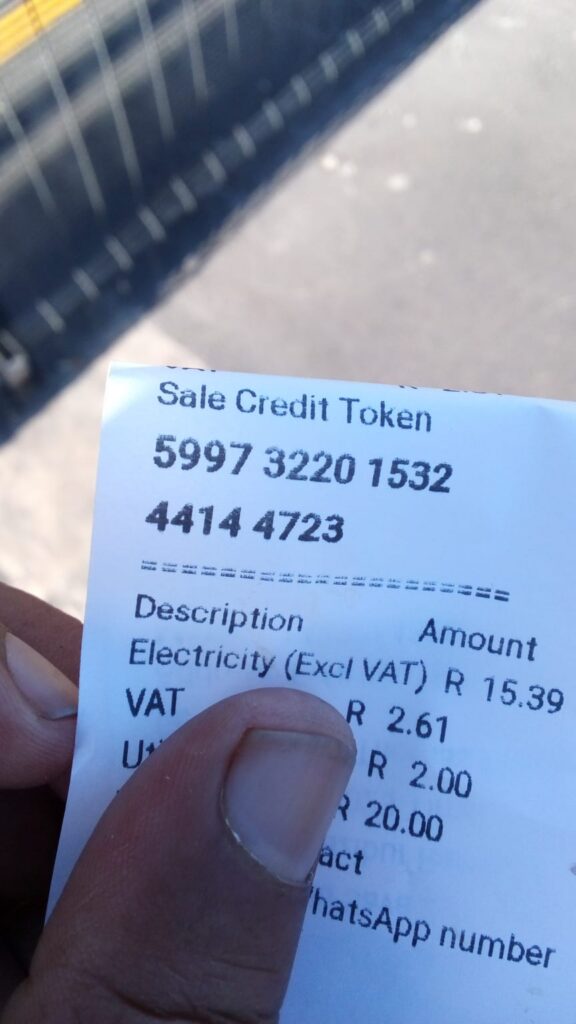
Your electricity slip is one of the easiest places to see what happened after a purchase.
Look for:
- Your tariff
- kWh received
- Free units
- Any charges or deductions
- The date of the purchase
Keep the slips if you are trying to work out why your allocation has changed.
If something looks different from the previous month, you can investigate before making another large purchase.
Watch the 250 kWh line
If your household normally sits below 250 kWh, keep an eye on your monthly purchases.
Crossing into the next range can reduce your free allocation from 60 units to 25.
That is a difference of 35 free units in a month.
Watch the 450 kWh line even more closely
The 450 kWh threshold is the one that can change your tariff altogether.
If your household has been using more electricity during winter, has added another appliance or has had more people living at home, your average can rise over time.
A single month of higher usage does not tell the whole story. Keep checking the 12-month picture.
What to do if you expected free electricity but received none
Start by checking the tariff printed on your latest electricity slip.
If it says Lifeline, look at the number of units received and your current average. You may have moved from the 60-unit allocation to the 25-unit allocation.
If the slip shows Domestic or Home User, the free allocation does not apply to that tariff.
You can then check whether:
- Your property value places you outside the Lifeline category.
- Your 12-month average has gone above 450 kWh.
- Your electricity connection has been placed on a different tariff.
- Your meter or account details need to be checked.
- You qualify for a rebate or relief that could affect your tariff.
- Your indigent application needs further attention.
If your tariff looks wrong, take your latest electricity slip and municipal account details to the relevant City customer service point or subcouncil and ask for the account to be checked.
How to avoid surprises next month
A few simple checks can make the system easier to manage.
Buy a small amount early in the month.
A small first purchase lets you see the tariff and free allocation before you spend more.
Check the kWh rather than only the rand value.
The amount of money you spend does not tell you how close you are to the usage thresholds.
Keep your slips.
They give you a record of your purchases and the tariff applied.
Track your 12-month average.
The monthly figure can change while the longer-term average tells you whether you are staying inside the Lifeline limits.
Be careful with large prepaid purchases.
A big purchase can increase the electricity received for that month, even if you plan to use the units over several months.
Check your tariff whenever something changes.
If your free allocation suddenly drops or disappears, check the tariff before assuming the benefit has been removed by mistake.
The bottom line
Free basic electricity is tied to the Lifeline tariff, your electricity usage and the rules used to calculate your 12-month average.
If your average stays below 250 kWh, you can qualify for 60 free units. Between 250 and 450 kWh, the allocation drops to 25 units. Once your average moves above 450 kWh, you can lose the Lifeline tariff and the free allocation.
Your property value can also place you on the Domestic or Home User tariff, where free units are not included.
The best way to avoid confusion is to check your tariff, read your electricity slip after every purchase and keep a monthly record of the kWh you receive.
That way, you can see a change in your electricity allocation before it becomes a surprise at the meter.
About The Author
