11 Inspirational Coloured People Who Made History
Cape Town’s history is a patchwork of voices, some celebrated, others overlooked. Among them are these celebrated Coloured individuals.
Our coloured mense have always had a seat at the table, even when the world wasn’t sure where we belonged.
We’ve made history in ways that weren’t always loud or obvious but that have had lasting effects. Some fought for equality. Others broke new ground in the arts or public service. But we managed to carve out spaces where our voices mattered.
In this post, we’re celebrating ten coloured trailblazers who showed us that history is made in all kinds of ways.
Coloureds Who Made History By Being First
Krotoa
Born in the early 1640s, Krotoa, later known as Eva, became a servant in Jan van Riebeeck’s home, the Dutch leader who first set up a colony at the Cape. While working there, she learned both Dutch and Portuguese, breaking new ground as the first Khoi woman to speak those languages. She was also the very first Southern African of indigenous origin to be baptised into the Christian faith.
Abdullah Abdurahman
Dr Abdullah Abdurahman (1872-1940) was the first person of colour elected to a political office in South Africa. Starting 1904, he represented some of the most disadvantaged communities in Cape Town. He was their voice on the City Council and later, the Provincial Council.
Dr. Abdurahman’s most passionate support was for the people of District Six, whose struggles he made his own. Although his efforts shaped the course of the city’s history, his name is rarely mentioned today.
Harold Cressy
When Harold Cressy (1889 – 1916) earned his BA in 1910, he made history as the first coloured graduate of the South African College, the predecessor of the University of Cape Town.
In 1912, Cressy became principal of Trafalgar Public School, the only secondary school accepting coloured pupils then. He led efforts to establish the Teachers League of South Africa and was elected its inaugural President in 1913.
Cressy worked diligently as joint editor of the League’s publication and as an advocate for expanding educational opportunities for black South Africans.
Cissie Gool
Cissie Gool (1897 – 1 July 1963) fought for social change from an early age. She founded the National Liberation League in 1936 and was its first leader.
The NLL worked alongside the ANC, supporting strikes and protests in the 1940s against apartheid. Cissie spent over a decade on Cape Town’s City Council representing District Six, and in the process, she was the only woman there.
In the 1940s, she became president of the Non-European Front, continuing her fight for justice through passive resistance. Her political activism led to her arrest and, later, her ban under the Suppression of Communism Act in 1954.
Refusing to step back, she studied law at UCT and earned her LLB in 1962, becoming the first coloured woman to do so, and joining the Cape Bar just before her death.
Theresa Solomons
District Six native Theresa Mary Solomon joined the Black Women’s Federation in 1975. Her voice demanded change, echoing through protests and organisations.
She helped establish civic groups like CAHAC, part of the UDF in the Western Cape. Marches, calls for reform, basic amenities – her resolve strengthened with each detention or charge. Her groundbreaking tenure from 1995 to 1998 saw her become Cape Town’s first Coloured Deputy Mayor and Mayor.
Amy Kleinhans
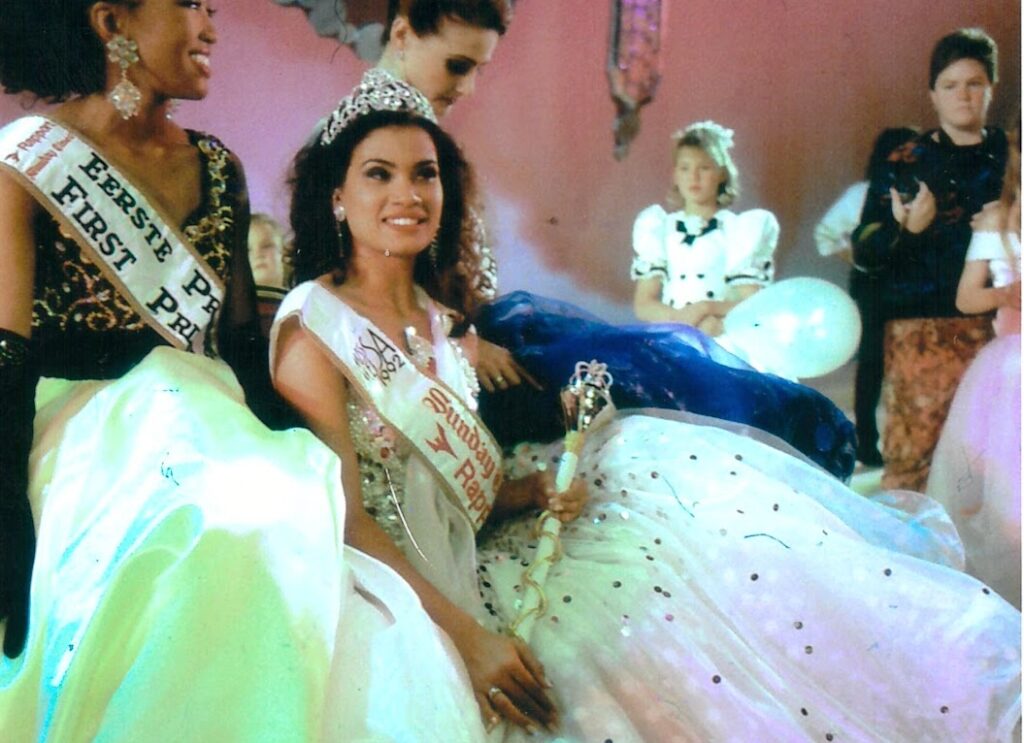
Amy Kleinhans-Curd changed the Miss South Africa landscape in 1992 by being the first Black winner. That same year, she competed in Miss World, ranking among the top five as Miss World Africa.
Gerald Morkel
In 1999, Gerald Morkel (1941 – 2018) took office as Premier of the Western Cape, a milestone as the first Coloured person to hold the role. Leading a coalition government, he helped set the stage for how politics would work in South Africa. As the DA’s leader in the province, he fought hard when many in his party left for the New National Party and the ANC.
Morkel was deeply committed to the cause, helping establish the democratic foundation South Africa stands on today.
Jonathan Jansen
Jonathan Jansen (born 1956) has shaped the conversation around education, both in South Africa and globally. As the first black rector and vice-chancellor at the University of the Free State, he has had a direct impact on the university system.
His books, like Knowledge in the Blood and Corrupted, examine issues of race, higher education, and the struggles within South African universities. In The Decolonisation of Knowledge, he pushes for a shift in how we think about and deliver education.
Wayde van Niekerk
In 2016, sprinter Wayde Van Niekerk had a historic year on the track. At the Rio Olympics, he shattered the 400m world record with a lightning-fast time of 43.03 seconds, beating Michael Johnson’s longstanding mark of 43.18. Earlier that year, Van Niekerk became the first and only sprinter to run under 10 seconds in the 100m, under 20 in the 200m, under 31 in the 300m, and under 44 in the 400m – all in the same season.
His record-breaking ways continued in 2017 when he set a new 300m world record of 30.81 seconds at the World Championships, a time he has held since 2018.
Zubeida Jaffer
Zubeida Jaffer is celebrated as the first African woman to win the coveted foreign journalist award from the National Association of Black Journalists in the USA. Starting her career in 1980 at the Cape Times and Rand Daily Mail, she later championed community journalism with Grassroots during apartheid. Her fearless reporting earned her accolades, including the Muslim Views Achiever Award and Missouri University’s Honor Medal. With her work published in Africa, the U.K., Japan, India, and North America, Jaffer’s voice continues to inspire and transform global perspectives on justice and humanity.
Tasneem Solomons
Tasneem Solomons is the first South African to win the World Eightball Pool Federation Women’s Singles World Masters title, a victory she secured in June 2024 in Blackpool, England. Playing pool for 20 years, Tasneem says the sport kept her on the right track when she was younger. Her final match was against Kirsty-Lee Davies, a former world champion from Wales, who Tasneem beat to take the top spot. It’s a huge moment for her and for South African pool.
When we think about Cape Town’s history the Cape Coloured community has a lot to show for itself. Their stories aren’t always celebrated but they are a crucial part of understanding how South Africa came to be.
About The Author