A Neighbourhood Guide to Manenberg
Manenberg’s streets are full of stories. This guide brings them to life, celebrating the neighbourhood’s heritage, residents, and spaces that define its character.
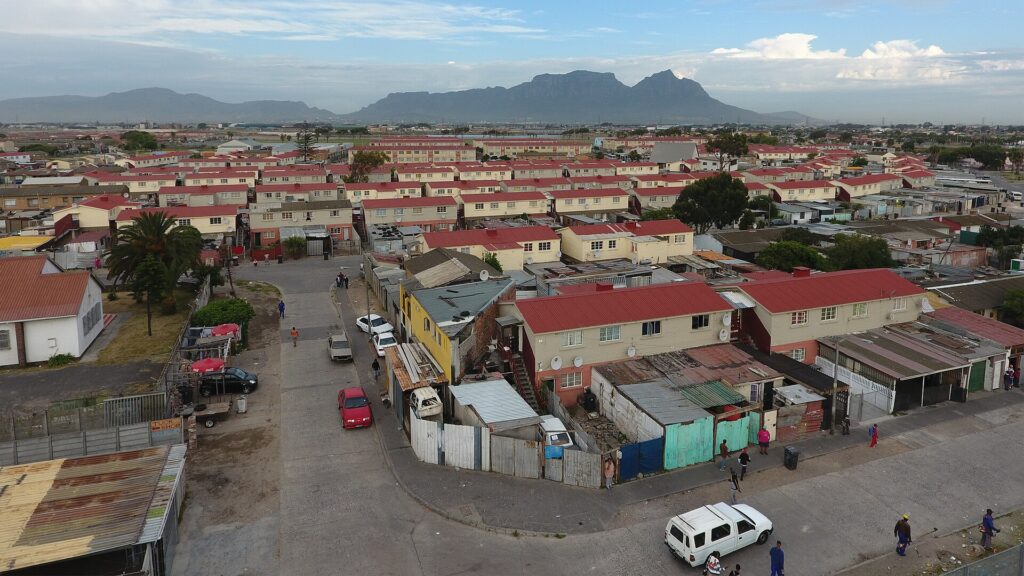
Manenberg Cape Town 2017" by Discott is licensed under CC BY-SA 4.0.
Manenberg is a Cape Flats suburb situated 17.8 km from Cape Town’s city centre (approximately 21 minutes by car) and just 7.1 km from Cape Town International Airport (about 8 minutes). The suburb is bounded by Heideveld to the north, Hanover Park and Athlone to the west, Philippi to the south, and Gugulethu to the east.
Table of Contents
Driving Directions to Manenberg
From the west, Manenberg is accessed via Turfhall Road, which branches off Jakes Gerwel Drive. From the north, Duinefontein Road — which connects to Klipfontein Road — provides an additional entry point.
History of Manenberg
Manenberg takes its name from an 1800s farm whose Afrikaans name translated roughly to “Man and Mountain.” Its story as a neighbourhood, however, begins in the darkest chapter of South African history.
As the apartheid government moved to enforce the Group Areas Act with increasing intensity, planning began in 1964 for a township that would absorb the thousands of Coloured families being torn from their homes across Cape Town. By 1966, Manenberg was established, receiving residents displaced from neighbourhoods the apartheid state had designated as white only — among them District Six, Constantia, the Bo-Kaap, Sea Point, Wynberg, Crawford, Lansdowne, and the Cape Town city centre. The township was designed from the outset to keep its residents at a structural disadvantage, with deliberately limited access to public facilities, resources, and employment opportunities elsewhere in the city.
Construction ran from 1966 to 1970, producing 5,621 homes to house nearly 34,000 people at a cost of just over R7 million. By 1975, the area had little more than a handful of corner shops and two liquor outlets to serve its entire population, with no commercial infrastructure or community services to speak of. A railway line running from the nearby black township of Gugulethu cuts through Manenberg itself, with Nyanga Railway Station eventually built to accommodate the growing populations of both areas. When housing shortages and informal settlement pressures mounted in the mid-1980s, 364 additional units known as maisonettes were added as part of an infill scheme, each offering three bedrooms, a living room, a kitchen, hot water, and a toilet — considered a relative improvement on what had come before.
The grinding conditions of life in Manenberg, shaped by the deliberate neglect baked into its very design, became a powerful engine of resistance. For many residents, the daily reality of overcrowding, inadequate services, and enforced poverty was not something to be endured quietly but something to be fought. That frustration found expression in widespread participation in anti-apartheid activities, including acts of civil disobedience that formed part of the broader movement to make the country ungovernable.
Public Transport
Minibus Taxis
Minibus taxis operate from Nyanga Junction and along Manenberg Avenue, picking up passengers en route. Additional stops are available along Klipfontein Road. Key routes include:
- Manenberg – Cape Town
- Manenberg – Claremont
- Manenberg – Mowbray
Golden Arrow Bus Services
Golden Arrow Bus Services (GABS) runs frequent daily commuter routes connecting Manenberg to destinations across the city:
- Manenberg – Cape Town
- Manenberg – Claremont
- Manenberg – Epping Industrial
- Manenberg – Hanover Park
- Manenberg – Heideveld
- Manenberg – Killarney
- Manenberg – Maitland
- Manenberg – Mowbray
- Manenberg – Wynberg
Metrorail
The closest train station to Manenberg is Nyanga Station, situated adjacent to Nyanga Junction shopping centre.

Population
According to the 2022 Census profile for the Manenberg Police Precinct, the area is home to 56,198 people spread across approximately 7 sub-places, with 13,259 households and an average household size of 4.2 people.
The community is predominantly Coloured (83.7%), followed by Black African residents (12.2%). The remaining population — Indian or Asian, White, and other unspecified groups — makes up less than 5% of the total. The median age is 31 years.
Looking at age distribution, just under a quarter of residents (23.4%) are children aged 14 and younger, 69.0% are of working age (15–64), and 7.6% are 65 or older. This translates to a youth dependency ratio of 33.9%, an elderly dependency ratio of 11.1%, and an overall dependency ratio of 45.0%.
Among adults aged 20 and older, a third (33.0%) have completed Grade 12 or hold a higher qualification. On the other end of the scale, 2.3% have had no formal schooling, 17.2% have some primary education, 5.6% completed primary school, and 35.3% reached but did not complete secondary school. For young children aged 5 and under, 34.7% attend a crèche or educare centre, 3.2% are in pre-school, 11.9% are with a day mother or child minder, 15.2% take part in a home or community playgroup, and 29.3% are not in any early childhood education programme.
Activism in Manenberg
When Manenberg was still finding its footing as a township in the years following forced removals, residents were already raising their voices. Figures like Faldielah de Vries, Frank Gutuza, Rushdi Majiet and Keith Karl Dumas moved through the streets and courts of Manenberg gathering people around the most pressing realities of daily life: crumbling infrastructure, unaffordable rents and the indignity of being housed in conditions that the state seemed determined to leave unaddressed.
The newspaper Grassroots, founded in 1980, became an invaluable record of this organising energy. Operating within the broader alternative press movement of that decade, it grew to a circulation of around 20 000 and served as a window into the lives of people in Manenberg and surrounding townships. One of its earliest pieces, published in March 1980 under the headline “Manenberg Tenants Stand Firm,” described how 600 residents came together to protest broken toilets and unpainted homes, forming the Duinefontein Tenants Association in the process. Rushdi Majiet was elected to chair the body, supported by a committee of twelve who helped residents draft petitions against rent increases. Frank Gutuza, then a director of the Silvertree Youth Centre, served alongside Majiet on the association’s steering executive.
This kind of organised resistance was a defining feature of Manenberg life from the 1970s right through to the 1990s. Across those decades, residents and activists built an array of civic structures: the Manenberg Civic Association, the Manenberg Educational Movement, the Manenberg Youth Organisation, the Manenberg Area Committee, Call of Islam, Ministers Organisations, the Manenberg People’s Centre, the Duinefontein Tenants Association, SHAWCO, the Silvertree Youth Centre, Self Help Manenberg, the Salvation Army, the Community Counselling Training Centre, the Urban Renewal Organisation and the Manenberg Community Police Forum. Each body reflected a different dimension of community need, yet together they formed a web of resistance to neglect and dispossession.
Grassroots captured moments of convergence between these organisations. One headline, “Manenberg Shows the Way Forward,” described a decision by the Manenberg Tenants Association and the Manenberg Educational Movement to coordinate their efforts, recognising that fragmented action could only go so far. Residents of Belinda Court similarly formed a court committee to address maintenance failures, a development the paper compared to the solidarity traditions of District Six, the neighbourhood from which so many Manenberg families had been uprooted. Another report, headlined “We Have the Power to Fight Evictions,” chronicled a march to the rent offices and gave voice to a spokesperson from the Manenberg Advice Office who observed that evictions were occurring at a rate of twenty a week. The marchers sent the message that housing, security and comfort were rights, and Manenberg’s people were prepared to fight for them.
By the 1980s a tighter inner circle of activists had formed, many of them shaped by the upheaval of 1976 and the uprising culture that followed. Mario Wanza, Faghie Johnson, Owen Munro, Irvin Kinnes, Christine Jansen, Faldielah de Vries, Emily Fairbairn, Mark Splinters, Maqbool Moos, Mickey Adams and others became central figures in a resistance movement that simultaneously mobilised publicly and organised in the shadows. Their work was nurtured in the classrooms and corridors of Manenberg’s three high schools, Phoenix High, Silverstream High and Manenberg High, where politically aware educators helped seed a culture of defiance.
Two groupings emerged from this milieu. The first, Manenberg Action Student Congress, known as MASCO, drew its membership primarily from teachers and students and occupied a more visible, moderate position. Its thirteen members operated openly, and the fact that teachers were among them was remarkable enough to be remarked upon at the time. The second grouping, the Manenberg Action Committee, was considerably more clandestine. Its membership shifted and overlapped with MASCO, with certain individuals moving between both worlds. They gathered quietly in the Manenberg Library to plan operations that ranged from tyre burnings and stone throwing to petrol bomb attacks, and eventually extended to armed resistance. Their training took place inside Manenberg itself.
Mario Wanza, Irvin Kinnes, Faldielah de Vries, Faghie Johnson, Mark Splinters, Maqbool Moos, Cameron Williams, Selwyn Daniels, Owen Munro and Mickey Adams anchored the first grouping. Shaheed Petersen, Mickey, Mario, Hattas, Faghie, Owen and others operated at the sharper edge of the second. Some of these activists had travelled into exile, been trained abroad and returned carrying ideas and skills that reshaped the movement at home. What they built together, across open meetings and secret gatherings, in classrooms and libraries and courtyard committees, permanently altered the character of Manenberg.

Crime in Manenberg
The latest data from the South African Police Service (SAPS) shows a deeply concerning surge in violent crime for the Manenberg policing precinct.
Historically known as a hotspot for gang-related activity, Manenberg has recently re-entered the country’s top 30 most dangerous police stations for murder, a grim milestone it had managed to avoid for several consecutive years. During the third quarter release of the official crime statistics, Manenberg recorded an increase of 15 murders compared to the exact same quarter from the previous year.
This spike in lethal violence highlights the highly volatile nature of the localized turf wars happening on the Cape Flats, where roughly one in four murders is directly tied to gang activity. The rise in numbers comes despite targeted provincial interventions like the Law Enforcement Advancement Plan (LEAP), which managed to bring murder rates down in neighboring areas like Delft and Mitchells Plain, but has struggled to contain the flare-ups in Manenberg.
Looking at a slightly broader timeline to contextualize this trajectory, the first nine months of the previous year recorded 58 murders in the Manenberg precinct alone. When compared to the 42 murders recorded during the same nine-month window in 2018, it represents a massive 38% long-term increase in homicides.
While law enforcement continues to focus heavily on illegal firearm seizures and drug-related arrests in the neighborhood, the relentless rise in both murder and attempted murder underscores how deeply entrenched organized gang violence remains in the community
Manenberg Tornado
The Manenberg tornado was a rare and destructive tornado that struck the Cape Flats area of Manenberg on 28 August 1999. It formed during severe storm conditions linked to a cold front moving across the southwestern Cape. Although tornadoes are uncommon in the Western Cape, the storm produced strong rotating winds that tore through informal settlements and residential areas, damaging homes, uprooting trees, and scattering debris across roads and open spaces.
Reports from the time described roofs being ripped off houses, walls collapsing, and residents fleeing for safety as the funnel moved through parts of Manenberg and nearby communities. Several people were injured, and hundreds were left displaced after homes and structures were damaged or destroyed. Emergency services and disaster relief teams responded to assist affected families with temporary shelter, food, and rebuilding support.
The tornado became one of the most talked-about weather events in Cape Town’s modern history because tornadoes are far more common in inland provinces such as the Free State and KwaZulu-Natal than in the Western Cape. Meteorologists later explained that the storm developed from intense atmospheric instability combined with strong wind shear during the cold front system. While relatively short-lived, the tornado left a lasting impression on residents because of the suddenness and violence of the event.
The Greens Sports Grounds
The Greens Sports Grounds – Manenberg is one of Manenberg’s best-known community sports spaces and has long been a central gathering point for local football and recreation. Located on the corner of Manenberg Avenue and Vygekraal Avenue, the complex serves as the home ground for many youth and community football activities in the area.
The facility is built around football culture, especially local league and youth development matches. For many residents, “The Greens” is a community safe space where children and teenagers can spend time playing sport and staying involved in structured activities. Local football officials have described it as a source of pride and one of the safest sporting environments in the neighbourhood during match days.
In recent years, the City of Cape Town invested millions of rand into major upgrades at the complex. The redevelopment added a full-size astro turf football field, two smaller five-a-side synthetic pitches, floodlights for evening games, multi-purpose courts for sports like basketball and netball, a running warm-up track, outdoor gym equipment, play areas, fencing, lighting, and upgraded walkways.
The atmosphere at The Greens is usually lively on weekends, with local football clubs, families, spectators, and street vendors gathering around matches and tournaments. The venue has become closely linked with Manenberg’s football identity and youth talent development, especially through the Manenberg Local Football Association.
Businesses and Shops in and Around Manenberg
- Grocery Stores, Supermarkets & Wholesalers
- Aman Supermarket & Wholesaler
- Highlands Wholesalers Cc
- Shoprite Nyanga Junction (Nyanga Junction Centre, Duinefontein Rd)
- M.Adam & Cos Supermarket (21 Cnr Putney Rd & Goldbourne Rd)
- Obama’s Corner Shop (Manyano St)
- The Bargain Store (Shop No. 10, Hazel Park, Hazel Rd)
- A&H Bargain Store Athlone (12 Comity St)
- Bangla Bazar (Indian Grocery · 38B Mabel Rd)
- Orient Fruit & Veg. (354 Manenberg Ave)
- Tuck Shops, Corner Shops & Convenience Stores
- Abdullah’s Tuck Shop (28A Great Fish Ave)
- African Tuck Shop (Oliver Tambo Ave)
- Al-Aqsa Tuck Shop (York St)
- Bismilah Corner Shop (The Downs Rd)
- Connection 3 (Pam Rd)
- Faldela Tuck Shop (3 Jade Cres)
- Family Tuck Shop (27 Oliver Tambo Ave)
- Faizel Tuck Shop (The Downs Rd)
- FreshStop Duinefontein (Duinefontein Rd)
- MANA TUCK SHOP (11 Van Reenen St)
- Noor Tuck Shop (15 Sparrow St)
- Oromia 11 Tuck Shop (Renoster Rd)
- Talk To Me Cash Store (96 Oliver Tambo Ave)
- Tamaam Tuck Shop (Manenberglaan)
- Tambo Avenue Spazza (105 Oliver Tambo Ave)
- Wayda’s Tuck Shop (1D Renoster Rd)
- Butchers & Meat Markets
- Adam’s Moslem Meat Market (326 Vistula Ln)
- Amardien trading (56 Jordan St)
- Manenberg Meat Market (The Downs Rd)
- Mama’s Pride Chicken PTY Ltd (Nyanga Junction, Duinefontein Rd)
- Clothing, Shoes & Fashion Markets
- Anawar Shop (3 Rio Grande Walk)
- Bone Ville Clothing Brand (22 Ray Alexander St, Tambo Village)
- Clothing & Printing (127 Irvine St)
- Got to Have It (Clothes Market · 44 Oleander St)
- Maboys (Shoe Store · Shop 40 Nyanga Junction)
- Muzah’s Gala (Shoe Store · 09 Mcosana St)
- Poormans Friend (Shoe Store · Shop 48 Nyanga Junction)
- Raadiyah’s Clothing and Footwear (29 Audrey Rd)
- Savers (Men’s Clothing · 14c Rio Grande St)
- Sneaker Life (2 Audrey Rd)
- Street Fever Manenburg (Nyanga Junction)
- StylebyAaliyah (Women’s Clothing · 292 Manenberg Ave)
- Trail Mod Cape (20 Moefieda Cl)
- Bakeries & Dessert Shops
- Asa’s Homestyles (28 3rd Ave)
- Birdybake (3rd Ave)
- Cookson’s House of Cakes (52 Jordan St)
- Delia’s Cakes (Tambo St)
- Kweishies (Candy Store · 71 Piele Ave)
- Manenberg 1a Silverstream (14 Elizabeth Rd)
- Niecy’s muffins&cakery (15b Wye Rd)
- P&G CAKES (15 Jordan St)
- Soraya’s Dessert Cartel (3c Sabie Rd)
- The Waffle House 7764 (46 Gail Court)
- Fast Food & Restaurants
- Bees Take Aways (341 Manenberg Ave)
- Gatsby King Take Aways (Helen Joseph)
- Hardware & Home Goods
- Dawood Painters (Building Materials · 7 Scheldt Walk)
- Gershwin (35 Letaba Rd)
- Majiets Hardware Store (245 Manenberg Ave)
- ZN Hardware (Nyanga Junction, Duinefontein Rd)
- Zhaa (25 Onyx Cres)
- Automotive, Tyres & Petrol Stations
- BP Gas Station (The Downs Rd)
- Caltex Duinefontein Service Station (Duinefontein Rd)
- Julies Tyres (Corner Klipfontein Rd & Silverstream Rd)
- Juma Tyres
- Mr.B’s Tyre Workshop (300 Manenberg Ave)
- Rooper (Auto Parts · 37 Jenny Schreiner St)
- Shopping Malls & General Wholesalers
- Gugulethu Square (NY1)
- Gugulethu Mall Maynard Mall (Cnr of Wetton and Main Rd)
- Nyanga Junction Shopping Centre (Duinefontein Rd)
- Osman’s Store (Wholesaler · Gatesville Shopping Centre)
- Health, Beauty & Cosmetics
- Gentle Gems Hand-crafted Soap (42 Lower 5th Ave)
- Junction Cosmetics Herbs & African Muthi (1 Duinefontein Rd)
- Lyden Barber Shop (Irvine St)
- Loyalty Barber Shop (Manenberglaan)
- Moosa Organic Herbal Sales (32 Mcosana St)
- New Look Cosmetics (Valhalla Dr)
- Printing, Stationery & Electronics
- Bailey’s Print Shop (35 Thames Walk)
- Coastal Green Trading (Stationery · 112 Sirius Rd)
- Eco Soapies (Electronics · Nellie Rd)
- I & N Appliances (Pty) Ltd (52 Kei St)
- Iman Cellular (Phone Repair · 08 Hazel Rd)
- Kamo Effects Printing (Screen Printing · 15 Friesland Cres)
- Kitera Trading (Ny108 and NY 1)
- Nmbqt Printing Solutions (75 Wye Rd)
- Liquor Stores
- Manenberg Liquors (Shop 2 Nyanga Junction)
- Vido’s Liquor Store (80 Oliver Tambo Ave)
- General Stores, Markets & Miscellaneous
- Abee’s Cash Store (75 Manenberglaan)
- Al-Jazeera Shop (12 Thames Ave)
- Azmizu Traders (Second-hand Store · 41 Tugela Rd)
- Bargain Box (Discount Store · 293 Manenberg Ave)
- Everyday I’m Hustling (Smart Shop · 122A Irvine St)
- Everything By Kai (Market · 49 Elsjieskraal Rd)
- Haji Stores (22 Bahama Cl)
- Jay & Jai Traders (20c Renoster Rd)
- Luvuthando Dolls (Brahman St)
- MANENBERG GAS (Gas Supplier · 123 Ruimte Rd)
- Manchester Shop (Ny 115)
- Minted Markets (Night Market · 4th Ave)
- Mombasa Shop (49 Oliver Tambo Ave)
- Nuries Work (Variety Store · 2nd Ave)
- Unmanned Joy (Toy Store · 23 Dorothy Zihlangu St)
Education
Primary Schools
- Manenberg Primary School
- Silverstream Primary School
- Talfalah Primary School
- Red River Primary School
- Edendale Primary School
- Rio Grande Primary School
- Downeville Primary School
- Sonderend Primary School
- Easter Peak Primary School
- Saambou Primary School
Secondary Schools
- Manenberg Secondary School
- Phoenix Secondary School
- Silverstream Secondary School
Combined / Independent Schools
The Leadership College (Junior, Middle & Senior)
Places of Worship
- Holy Family Catholic Church.
- Church of the Reconciliation Manenberg
- AFM / AGS Manenberg – Worship Centre – House of Restoration
- Silverstream Tabernacle Church Of God In Christ
- United Pentecostal Church Of Manenberg
- Moravian Church Manenberg
- Acts Mission Church Of S.a.
- City Of Refuge Community Ministries
- Lily Ministry Bible Church
- New Apostolic Church Manenberg
- Tree of Life
- Green Pastures Restoration Ministries
- Disciples of God Pentecostal Ministry
- Pentecostal Protestant Church.
- Old Apostolic Church, Manenberg
- Methodist Church Of S.a.
- Calvary AME Church Mannenberg.
- Jireh chapel ecc
- Emmanuel Baptist Church.
- God’s People Ministries
- Galilean Gospel Mission Church
- Manenberg Church of the Nazarene
- Manenberg Mosque
- Masjid Jama’ah
Healthcare
- Drs Ahmed & Solomon — 55 2nd Ave, Manenberg. General practitioners/family doctors. Tel: +27 21 691 0046.
- Dr. S A Kagee — Corner of The Downs Road & Manenberg Avenue, Manenberg. General practitioner. Tel: +27 21 691 0181.
- Dr MF Petersen — Vistula Lane, Manenberg. General practitioner. Tel: +27 21 691 5101.
- Dr S Rylands — Corner of Manenberg Avenue & The Downs Road, Manenberg. Tel: +27 21 691 0180.
- Dr Gavin Van Wyk — Physician based in Manenberg. Tel: +27 21 690 1000.
- Dr Vallabh Kamil Ishwarlal — Emergency medicine practitioner. Tel: +27 21 690 1000.
Medical clinics in the area include:
- Manenberg Community Health Centre – T.B Unit
- Manenberg Satelite Clinic
About The Author